


Polyethylene (PE) and polypropylene (PP) are among the most widely used thermoplastic polymers, especially in the packaging, agricultural and consumer products industries. Their excellent mechanical strength, low cost, processability and chemical resistance have made them the dominant materials for applications such as shopping bags, films and containers. However, they have a major drawback of resistance to biodegradation due to their hydrophobic and chemically inert structure. As a result, discarded polyethylene and polypropylene products accumulate in landfills and natural environments, significantly contributing to the global plastic pollution crisis. To mitigate this environmental challenge, research has increasingly focused on the development of biodegradable or partially biodegradable polymer blends.
Starch is a promising additive, abundant, inexpensive, renewable and fully biodegradable under a wide range of environmental conditions, consisting of amylose and amylopectin, two polysaccharides that provide hydroxyl-rich surfaces. Starch-based plastics currently account for approximately 85–90% of the biodegradable polymer market, including packaging bags, agricultural films, etc. Despite the advantages of starch, the direct blending of starch with polyethylene and polypropylene faces significant challenges. The hydrophilic nature of starch is inherently incompatible with the hydrophobic and nonpolar nature of polyolefins. This incompatibility often results in poor interfacial adhesion, phase separation and reduction of key physical properties such as tensile strength and toughness.
Several methods have been proposed to improve the aforementioned compatibility, such as chemical modification of starch, addition of compatibilizers (e.g., PE or PP bonded with maleic anhydride). Sometimes, without the use of compatibilizers, the addition of starch can provide significant benefits in terms of cost reduction; provided that the desired formulation maintains the desired and sufficient mechanical properties for the intended application.
In a research and technological activity of Mahdad Pak Polymer Company, a polyethylene blend intended for the production of commercial packaging bags containing 40, 40, 10, 10 weight percent of respectively F7000 heavy polyethylene grade from Mehr Petrochemical, 5110 heavy polyethylene from Aria Sasol Petrochemical, linear light polyethylene from Shazand Petrochemical, and 0075 light polyethylene from Bandar Imam Petrochemical; was used as the PE polymer base. Native corn starch was obtained from Glucozan Company. In order to ensure greater compatibility between starch and the polymer substrate of the samples, acetic anhydride from Pars Shimi Company was used. In order to produce masterbatch for preparing laboratory samples, small amounts of PE bonded with maleic anhydride, industrial glycerol, stearic acid, acetic acid and caustic soda were also used.
In this study, three samples containing the aforementioned polyethylene blend were prepared in scenarios without additives (PE), containing unmodified starch (N-St) and containing modified starch (M-St) with a composition of 25% by weight. The composition percentage of the samples under study is as follows:
Table 4- Percentage composition of starch-containing samples
| Purpose | % | Composition |
| Polymer base | 65 | Polyethylene blend |
| Biodegradable additive | 25 | Starch (modified/unmodified) |
| PE-St compatibility improvement | 4 | PE-g-MA |
| Plasticizer | 4 | Glycerol |
| Lubricant (Processing aid) | 2 | Stearic acid |
Initially, corn starch was placed in an oven at 80°C for 2 hours to remove the moisture in the starch. Then, the ingredients mentioned in the above table were mixed in a high-speed mixer according to the respective percentage composition and poured into a KERKE model laboratory twin-screw extruder with a temperature range of 140°C to 180°C to prepare the N-St sample masterbatch.
In order to chemically modify the starch to create more suitable compatibility and interaction with the hydrophobic substrate of the polyethylene mixture, initially, acetic anhydride at an amount of 5% by mass and caustic soda at an amount of 1% by mass relative to the amount of starch were mixed in a heating mixer at a temperature of 75°C for 2 hours to carry out the chemical modification reaction of the starch. Then, the modified starch was washed with neutral acetic acid and distilled water to dry in an oven under the above-mentioned temperature conditions.
Finally, in order to prepare the desired samples for the tensile test, 45 grams of the masterbatches were subjected to a hot compression machine at a temperature of 150 °C for 5 minutes.
In this study, a single-column tensile testing machine with a capacity of 500 kg from Azma Polymer Sam Company was used to examine the mechanical properties of the samples under the ASTM D412 standard.
On average, the samples used in this test have an initial length of 165 mm, a thickness of 5 mm, and a width of about 13 mm. This test was performed at a speed of 500 mm/min.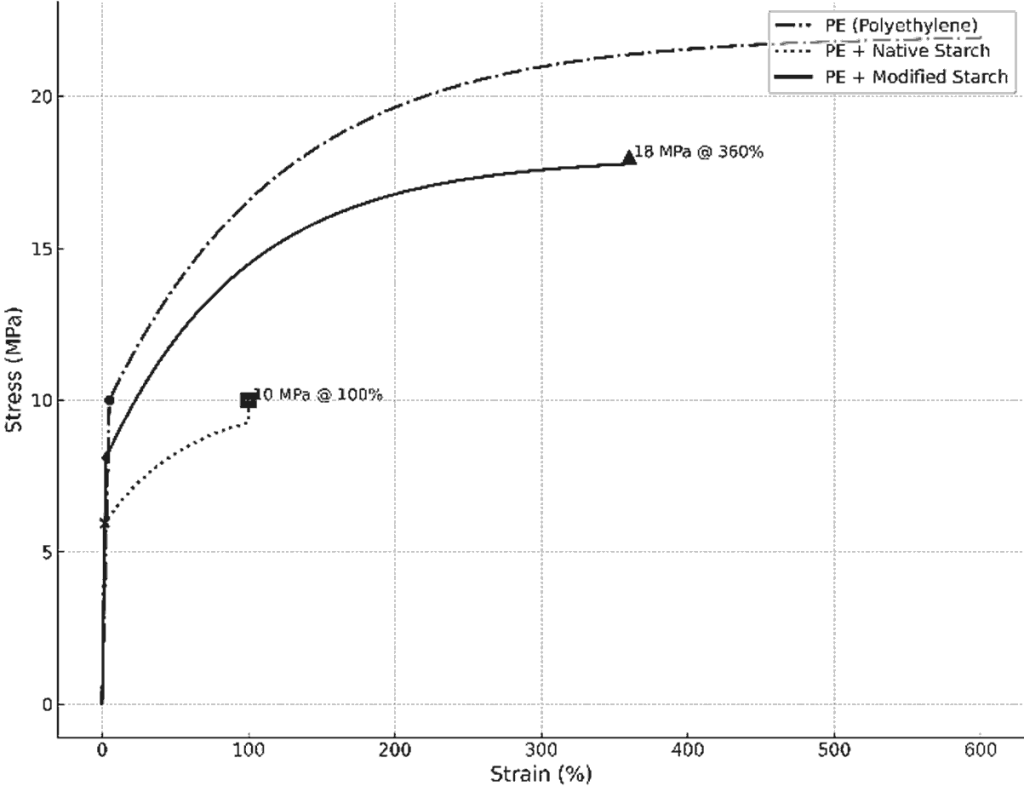
Graph of tensile test results of specific biodegradable product and company technology
The stress-strain diagrams presented in the figure above show the tensile behavior of unmodified polyethylene (PE), unmodified starch-containing polyethylene, and modified starch-containing polyethylene.
Unmodified polyethylene exhibits its typical thermoplastic and ductile behavior. The figure above shows a broad elastic zone with gradual hardening, ultimately reaching a strength of approximately 22 MPa at about 600% elongation. The high elongation indicates the excellent toughness and molecular chain mobility that are characteristic of polyolefins. This behavior provides polyethylene with desirable ductility and impact resistance, making it a suitable substrate for many polymer applications.
The addition of unmodified starch causes a significant reduction in strength and ductility. As shown in the figure above, the N-St sample breaks at a strength of about 10 MPa and 100% elongation, which indicates a brittle failure compared to the unmodified PE. This can be attributed to the inherent incompatibility between the hydrophobic PE with non-polar properties and the hydrophilic starch with polar properties. The poor adhesion and interaction between the polymer matrix and starch surfaces prevents the effective transfer of stress from the matrix to the starch particles, leading to premature separation and crack initiation at the filler-matrix interface. Also, the unmodified starch tends to aggregate in the polyethylene matrix due to the presence of hydroxyl functional groups, creating stress concentration points that accelerate failure. Although this sample maintains a somewhat high initial modulus due to the stiffness of the starch; However, its reduced ductility outweighs any advantage and makes the reinforcing properties of unmodified starch undesirable for certain applications. In contrast, the M-St sample shows a significant improvement in mechanical properties compared to the N-St sample, with strength reaching 18 MPa and elongation reaching approximately 360%. This increase in performance and improved mechanical properties can be directly attributed to the surface modification of the starch, which improves the interfacial compatibility with the polyethylene blend substrate.
Table 5- Results from tensile testing of company-specific biodegradable samples
| Strength (MPa) | Elongation (%) | Modulus (MPa) | Sample |
| 21.93±0.10 | 596.31±0.03 | 3.61±0.06 | PE |
| 9.41±0.08 | 102.30±0.09 | 9.25±0.09 | N-St |
| 17.86±0.07 | 362.52±0.19 | 4.92±0.11 | M-St |
Common surface modifications such as esterification with acetic anhydride, acetylation, or crosslinking with compatibilizers (e.g., PE crosslinked with maleic anhydride) reduce the hydrophilicity of the starch and increase its affinity for chemical bonding with the hydrocarbon chains of the polyethylene substrate. This improved interfacial bonding makes stress transfer more efficient and reduces starch extrusion, resulting in significant strength and ductility compared to the sample containing unmodified starch. Although the elongation of the M-St sample is still lower than that of the PE sample without the additive, this masterbatch balances the hardness and toughness, making it a more promising material for biodegradable packaging or semi-rigid applications.
As a conclusion, this study investigated the effect of adding unmodified and modified corn starch on the mechanical properties of a commercial polyethylene blend. The results of this study showed that the polyethylene blend without additives has normal strength and elasticity due to its tough structure. Adding unmodified starch led to a significant decrease in mechanical properties; so that the strength decreased by about 50% and the elasticity decreased to about 1.6. This decrease is due to the interfacial incompatibility between the hydrophobic substrate of the polyethylene blend and the hydrophilic starch particles, which causes the lack of proper stress transfer and premature failure of the sample. Therefore, the direct use of native corn starch in these blends has serious limitations. In contrast, the use of modified starch along with compatibilizing agents significantly improved the mechanical properties. The strength of this sample increased by about 2 times and the elasticity increased by about 3.5 times compared to the sample containing unmodified starch. Chemical modification of the starch surface resulted in reduced hydrophilicity, more uniform dispersion, and improved interfacial interaction, resulting in more effective stress transfer and higher strength. From an industrial perspective, it has been shown that the combination of polyethylene with modified biobased fillers can be a suitable option for the production of biocompatible materials, as in addition to acceptable mechanical properties, the advantage of biodegradability is also provided. However, there is still a gap with the properties of pure polyethylene, which indicates the need for further research in the field of advanced surface modifications, improved mixing processes, and the use of novel reinforcements.
No comment