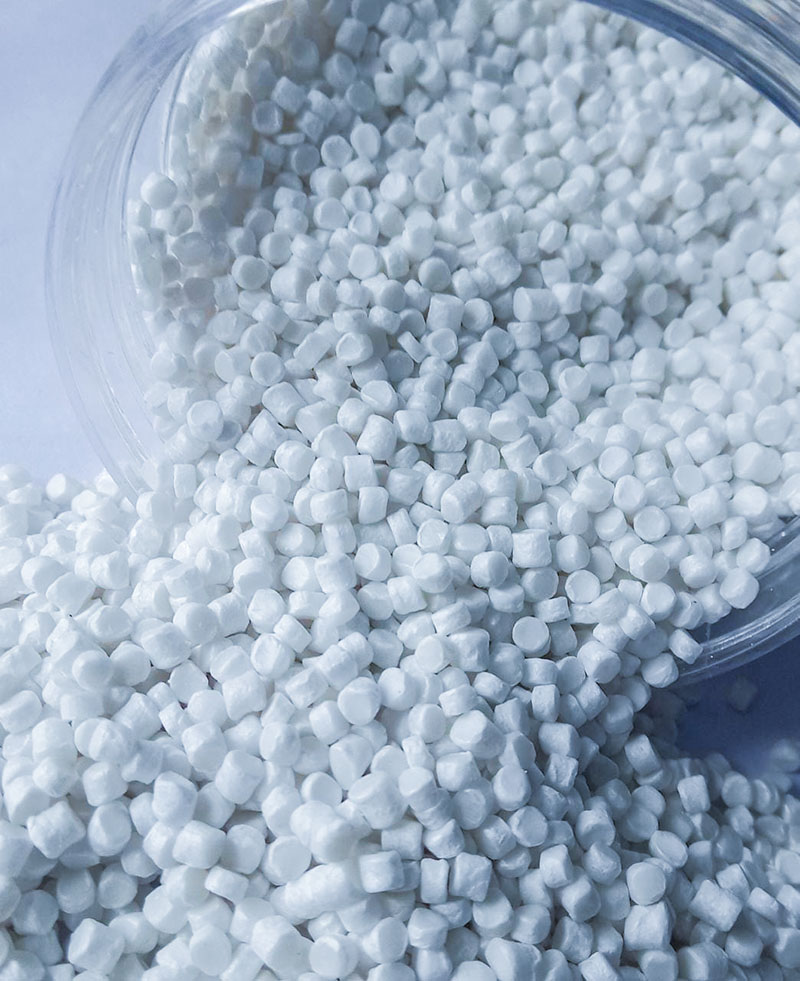


Polyethylene or polypropylene based filler masterbatches contain a high percentage (65-75%) of high quality calcium carbonate powder, which is used to reduce raw material costs and improve mechanical and process properties.
Calcium carbonate masterbatches are recognized as one of the key strategies in the polymer industry to achieve an optimal balance between performance, cost and environmental sustainability. By combining calcium carbonate mineral filler with polyethylene and polypropylene polymer bases, these masterbatches not only lead to a significant reduction in production costs, but also significantly improve the mechanical, thermal and optical properties of the final product. From a technical point of view, calcium carbonate particles with a high degree of purity and a controlled particle size in the micron range, after surface treatment with chemical agents such as stearic acid, are uniformly dispersed in the polymer matrix and modify the crystalline microstructure of the polymer by creating a nucleation effect. This results in increased modulus of elasticity, improved creep resistance, and increased thermal stability. Also, these masterbatches have a positive impact on reducing carbon footprint and cost-effectiveness of production by reducing virgin polymer consumption.
From a market perspective, these products have been widely accepted by industries such as pipes and fittings, film packaging, automotive parts, and building materials due to their formulation flexibility and compatibility with common production processes such as extrusion, injection, and blow molding. Especially in end-use applications that require a balance between strength, rigidity, and economy, calcium carbonate masterbatches are considered an ideal alternative to engineered full-polymer compounds. In addition, given the increasing trend of attention to the circular economy and sustainable production, these masterbatches are considered as a green solution that helps to protect the environment while reducing costs. A successful marketing strategy for these products is based on providing laboratory samples with different filler percentages, emphasizing economic savings without sacrificing quality, and providing international standard certificates. With the global market for these products forecast to grow by 5.2% annually until 2027, it seems that developing innovative formulations tailored to the specific needs of each industry will be the key to success in this competitive market.
Applications:
• Production of plastic bags (Shopping Bags, Garbage Bags)
• Agricultural films
• Plastic sheets
• Injection and extrusion parts
Advantages:
• Reduction in the cost of the final product
• Improvement in strength and hardness
• Improvement in processability
• Reduction in paint consumption
• Improvement in dimensional stability
Physical and mechanical properties (example of typical values):
• Density: 1.6–1.9 g/cm³
• Filler percentage: 70-85% CaCO3
• Tensile strength: medium to high (depending on the percentage used)
• Increased heat resistance